Wednesday, 8 June 2016


Komet PanSTARRS dan Helix Nebula


See Explanation.  Clicking on the picture will download
 the highest resolution version available.


Komet PanSTARRS dan Helix Nebula
Gambar Kredit & Copyright: Fritz Helmut Hemmerich

Sangat jarang bahwa objek yang berbeda tersebut dicitrakan begitu dekat bersama-sama. Seperti sebuah kesempatan yang terjadi sekarang, meskipun, dan ditangkap dua hari lalu di eksposur paralel gabungan dari Kepulauan Canary Spanyol. Di kanan bawah, dikelilingi oleh koma hijau dan berasal ekor ion biru biasa perpecahan diagonal frame, adalah Comet C / 2013 X1 (PanSTARRS)
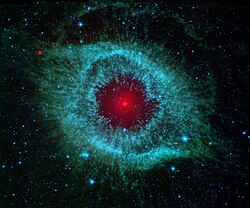
Comets Kick up Dust in Helix Nebula (PIA09178).jpg

                     Helix Nebula yang diambil oleh Spitzer teleskop ruang angkasa (Infrared,)


Bola salju raksasa ini telah jatuh ke arah Matahari dan cerah sejak penemuannya pada tahun 2013. 

Meskipun Comet PannSTARRS adalah target indah untuk eksposur panjang durasi dari astrophotography, diharapkan menjadi hanya nyaris tak terlihat dengan mata telanjang ketika mencapai kecerahan puncaknya di bulan berikutnya. Pada bagian kiri atas, dikelilingi oleh gas merah menyala, adalah juga-indah Helix Nebula. Pada 700 tahun cahaya jauh, Helix tidak hanya lebih jauh daripada komet, namun diperkirakan untuk mempertahankan penampilan selama ribuan tahun

Wednesday, 13 April 2016

westerlund 1 bks as

Inilah Bintang Terbesar Sejagad yang Mengalahkan NML Cygni

Inilah Bintang Terbesar Sejagad yang Mengalahkan NML Cygni
Kluster bintang Westerlund, lokasi bintang terbesar sejagad yang baru diketahui. Kredit: NASA
Seperti yang kita ketahui saat ini, bintang terbesar di alam semesta adalah NML Cygni. Namun, ada yang lebih besar lagi. Yakni Westerlund 1 BKS AS.

Sebelumnya juga pernah ada bintang terbesar bernama VY Canis Majoris, namun kemasifannya dikalahkan NML Cygni. Saat ini, NML Cygni mungkin bukan lagi yang terbesar sejagad.

Bintang Westerlund 1 BKS AS atau juga bisa disebut Westerlund 1 W26, adalah bintang yang terletak pada jarak 16.000 tahun cahaya dari Bumi (1 tahun cahaya = 9,4 triliun kilometer).

Bintang ini terletak di kluster atau gugus bintang Westerlund di konstelasi Ara. Radius bintang Westerlund 1 BKS AS adalah 1.951 hingga 2.544 radius Matahari atau 16,64 miliar kali lebih besar dari Matahari.

Jika Westerlund 1 BKS AS ditempatkan di pusat tata surya kita, permukaannya akan mencapai Saturnus. Artinya, Bumi bukan planet layak huni lagi.

Diameter bintang ini adalah 3,54 miliar kilometer, sedangkan NML Cygni hanya berdiameter 2,29 miliar kilometer. Bintang ini juga merupakan bintang hiper-raksasa merah.

Dalam urutan bintang terbesar di alam semesta yang diketahui, Westerlund 1 BKS AS berada di urutan pertama, diikuti UY Scuti di urutan kedua. NML Cygni di urutan ketiga sedangkan VY Canis Majoris di urutan kedelapan.

https://www.youtube.com/watch?v=E8uU6nEklzc

V354 Cephei
V354 Cephei is a red supergiant star located within the Milky Way. It is an irregular variable located approximately 9,000 light-years away from our Sun, and is currently considered one of the largest known stars, with a radius estimate of 1,520 times that of the Sun, or 1,060,000,000 km at its greatest extent. If it were placed in the center of the Solar System, it would extend to 7 AU, between the orbits of Jupiter and Saturn.
The luminosity, and hence the size, of V354 Cep are disputed. Levesque et al 2005, find a high luminosity and consequently very large size of 1,520 R, making it one of the List of largest stars. From the same data, Mauron et al 2011 derive a much smaller luminosity of 76,000 L, which implies a much smaller size around 690 R. They note the discrepancy but are unable to explain it.[7]
There are similar differences in the visual extinctions derived, between two and six magnitudes.


    V354 Cephei
    Observation data
    Epoch J2000.0      Equinox J2000.0 (ICRS)
    ConstellationCepheus
    Right ascension22h 33m 34.643s[1]
    Declination+58° 53′ 47.05″[1]
    Apparent magnitude (V)10.82 to 11.35[2]
    Characteristics
    Spectral typeM2.5 Iab[3]
    B−V color index+3.18[4]
    Variable typeLC[2]
    Astrometry
    Distance~9,000[5] ly
    (3,500 pc)
    Absolute magnitude (MV)-7.57 (variable)[4]
    Details
    Radius1,520[6] R
    Luminosity76,000[7] - 369,000[6] L
    Surface gravity (log g)−0.5[6] cgs
    Temperature3,650[6] K
    Other designations
    V354 Cep, Case 75,2MASS J22333464+5853470,IRAS 22317+5838
    Database references
    SIMBADdata

    Orion Nebula( Messier 42, M42, or NGC 1976)

    Orion Nebula (also known as Messier 42, M42, or NGC 1976
    Orion Nebula - Hubble 2006 mosaic 18000.jpg
    The entire Orion Nebula in a composite image of visible light and infrared.
    The Orion Nebula (also known as Messier 42M42, or NGC 1976) is a diffuse nebula situated in the Milky Way, being south of Orion's Belt in the constellation of Orion.[b] It is one of the brightest nebulae, and is visible to the naked eye in the night sky. M42 is located at a distance of 1,344 ± 20 light years[3][6] and is the closest region of massive star formation to Earth. The M42 nebula is estimated to be 24 light years across. It has a mass of about 2000 times the mass of the Sun. Older texts frequently refer to the Orion Nebula as the Great Nebula in Orion or the Great Orion Nebula.[7]
    The constellation of Orion with the Orion Nebula (lower middle)
    The Orion Nebula is one of the most scrutinized and photographed objects in the night sky, and is among the most intensely studied celestial features.[8] The nebula has revealed much about the process of how stars and planetary systems are formed from collapsing clouds of gas and dust. Astronomers have directly observed protoplanetary disksbrown dwarfs, intense and turbulent motions of the gas, and the photo-ionizing effects of massive nearby stars in the nebula.
    Optical images reveal clouds of gas and dust in the Orion Nebula; an infrared image (right) reveals the new stars shining within.
    The Nebula is part of a much larger nebula that is known as the Orion Molecular Cloud Complex. The Orion Molecular Cloud Complex extends throughout the constellation ofOrion and includes Barnard's Loop, the Horsehead NebulaM43M78, and the Flame Nebula. Stars are forming throughout the entire Cloud Complex, but most of the young stars are concentrated in dense clusters like the one illuminating the Orion Nebula

    Friday, 27 November 2015

    si Rakus

    Galaksi Remaja yang Rakus


    Selama beberapa waktu astronom sudah tahu kalau galaksi-galaksi itu ukurannya jauh lebih kecil ketika Alam Semesta masih muda. Di sepanjang masa Alam Semesta, galaksi-galaksi terus bertambah berat, tapi pola makan dan juga apa yang mereka makan masih misteri.
    Galaksi-galaksi jauh yang diamati dirasi Cetus yang saat remaja melahap galaksi lebih kecil. Kredit : ESO/CFHT
    Saat ini, ada tim astronom yang memata-matai galaksi saat mereka sedang makan malam. Caranya, galaksi-galaksi ini dilihat dengan menggunakan teropong bernama Very Large Telescope. Hasilnya adalah foto di atas yang menunjukkan beberapa galaksi ( tanda silang merah) yang sedang diamati para astronom.
    Very Large Telescope adalah sebuah teleskop yang hebat yang bisa melihat ke masa lalu, masa ketika galaksi-galaksi itu masih remaja. Melihat kembali ke masa lalu, terdengar seperti cerita fiksi sains bukan? Padahal sebetulnya idenya sangat sederhana: Cahaya dari galaksi yang sangat jauh membutuhkan waktu miliaran tahun untuk bisa tiba di Bumi. Karena itu, apa yang dilihat para pengamat adalah galaksi-galaksi itu ketika berumur miliaran tahun lalu ! (Untuk informasi lebih lanjut, klik disini.)
    Dari hasil pengamatan, para astronom menemukan kalau galaksi ketika baru memasuki usia remaja sangat suka memakan gas. Tapi, galaksi di akhir masa remaja lebih suka makanan yang lebih besar dan mereka melahap galaksi yang lebih kecil.  Pada umumnya, galaksi-galaksi akan semakin rakus ketika usianya bertambah dan bahkan mereka berubah menjadi kanibal atau pemakan sesama!
    Fakta Menarik: Galaksi yang diamati ini memiliki nafsu makan yang luar biasa besar seperti monster. Ia ditemukan di langit malam di Rasi bintang “Cetus” yang artinya “Monster Langit”!

    Thursday, 19 November 2015

    THE LEO

    2015 November 20
    See Explanation.  Clicking on the picture will download
 the highest resolution version available.
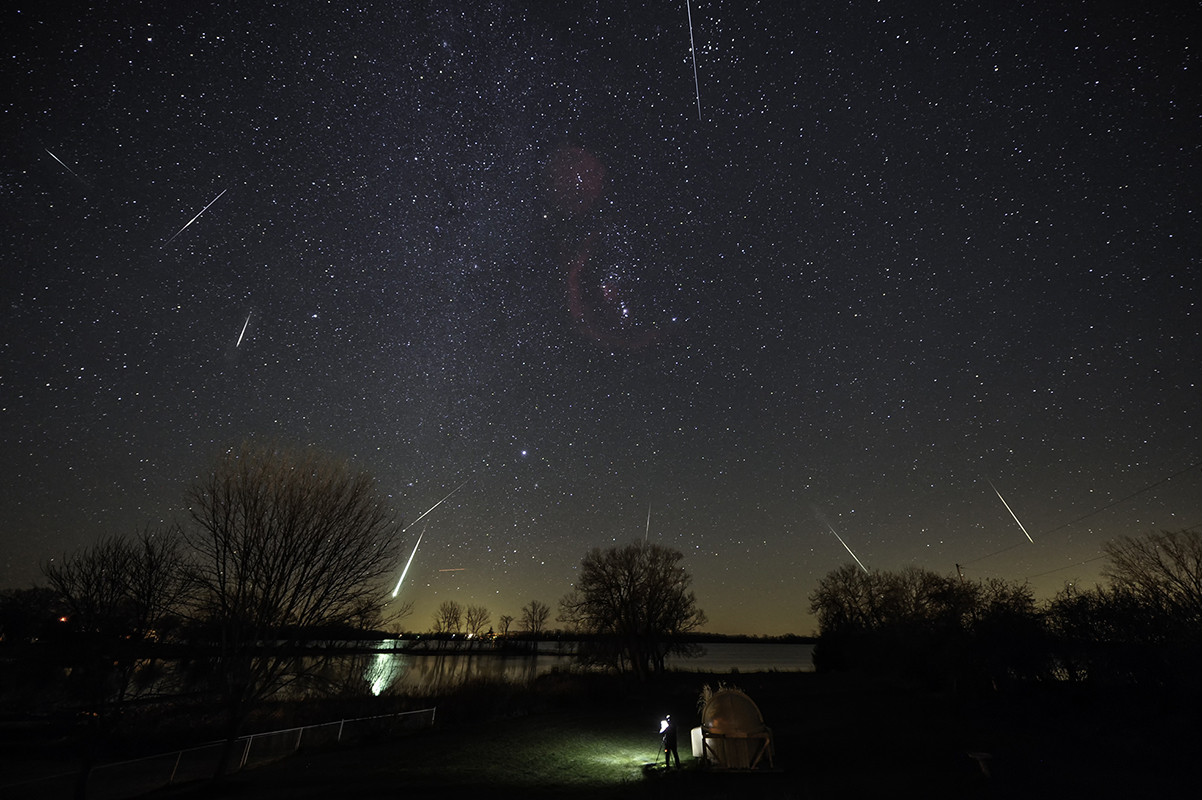
    Leonids and Friends 
    Image Credit & Copyright: Malcolm Park (North York Astronomical Association)
    Explanation: Leonid meteors rained down on planet Earth this week, the annual shower of dusty debris from the orbit of Comet 55P/Tempel-Tuttle. Leonids streak through this composite night skyview from a backyard observatory in southern Ontario. Recorded with camera fixed to a tripod, the individual frames capture the bright meteor activity throughout the night of November 16/17, about a day before the shower's very modest peak. The frames are registered to the fixed field of view, so the meteor trails are not all aligned to the background star field recorded that evening when Orion stood above the southern horizon. As a result, the trails don't appear to point back to the shower's radiant in Leo, situated off the left edge of the star field frame. In fact, some trails could be of Taurid meteors, a shower also active in November, or even sporadic meteors, including a bright fireball with its reflection near the horizon.

    Wednesday, 4 February 2015

    See Explanation.  Clicking on the picture will download
 the highest resolution version available.
    M104: The Sombrero Galaxy


    Image Data: NASA, ESO, NAOJ, Giovanni Paglioli - Pengolahan: R. Colombari
    Penjelasan: spiral galaksi M104 mencolok terkenal tepi-on hampir nya profil menampilkan cincin luas menutupi jalur debu. Dilihat dalam siluet terhadap tonjolan luas bintang, petak debu kosmik meminjamkan bertepi penampilan hat-seperti luas untuk galaksi menunjukkan moniker lebih populer, The Sombrero Galaxy. Hubble Space Telescope dan data Subaru tanah berbasis telah diproses ulang dengan data gambar warna amatir untuk membuat tampilan ini tajam galaksi terkenal. Hasil pengolahan dalam penampilan warna alami dan mempertahankan rincian sering hilang dalam silau besar tonjolan pusat terang M104 ketika dilihat dengan tanah berbasis instrumen yang lebih kecil. Juga dikenal sebagai NGC 4594, galaksi Sombrero dapat dilihat di seluruh spektrum dan diperkirakan menjadi tuan rumah sebuah lubang hitam supermasif pusat. Sekitar 50.000 tahun cahaya dan 28 juta tahun cahaya, M104 adalah salah satu galaksi terbesar di tepi selatan Virgo Galaxy Cluster.

    Besok gambar: semua kelereng
    <| Arsip | Kiriman | Pencarian | Kalender | RSS | Pendidikan | Tentang APOD | Discuss |>
    Penulis & Editor: Robert Nemiroff (MTU) & Jerry Bonnell (UMCP)
    NASA Resmi: hak khusus Phillip Newman berlaku.
    NASA Kebijakan Privasi dan Pemberitahuan Web Penting
    Sebuah layanan: ASD di NASA / GSFC
    & Michigan Tech. U.